
In a world increasingly dominated by high-definition screens and digital perfection, we are surrounded by flatness. We consume images that are perfectly smooth, backlit, and devoid of physical presence. While digital art has its place, it lacks the one thing that connects us to the physical world: Texture. For me, as an abstract artist, texture is not just a secondary detail; it is the heartbeat of the work. I believe that “flat” is the enemy of engagement. A flat painting asks the eye to look at it once and move on. A textured painting, however, asks the eye to linger, to explore, and to feel. By incorporating materials like burlap, duck cloth, crushed quartz, and banana fiber, I am building a landscape that exists in three dimensions, even if it hangs on a two-dimensional wall.
The Philosophy of the Tactile
When I stand before a blank canvas, I am not just thinking about color; I am thinking about “surface tension.” I want to create a work of art that changes as you walk past it. If a painting is flat, the light hits it the same way from every angle. But when you introduce physical relief—peaks, valleys, and grit—the light begins to play with the art.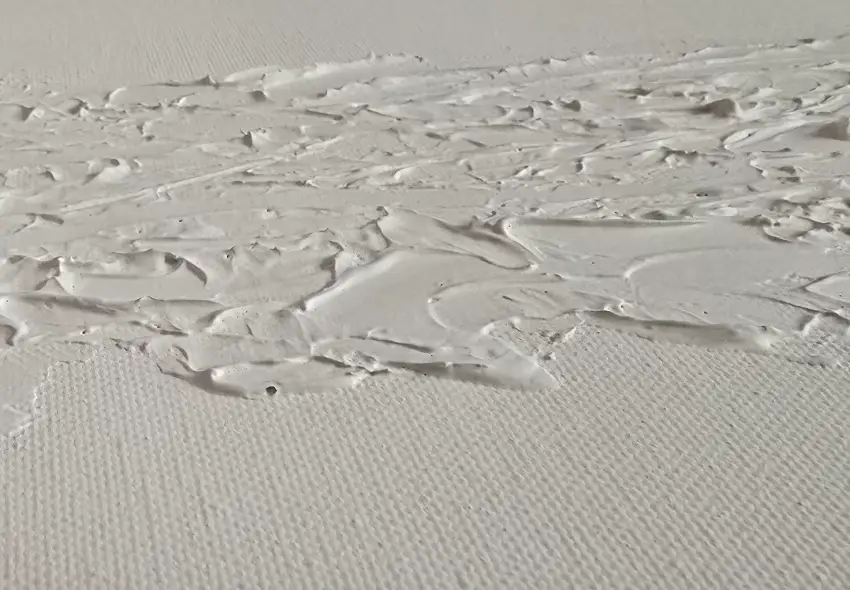
Throughout the day, as the sun moves across a room, a textured painting “breathes.” A shadow might fall into a crevice created by a piece of heavy duck cloth, or a stray beam of light might catch the edge of crushed quartz, creating a momentary glint that wasn’t there an hour before. This makes the art a living entity. It is the difference between looking at a photograph of a mountain and actually standing on its rocky, uneven surface.
The Material Palette: Nature Meets the Canvas
My “toolbelt” goes far beyond the traditional tubes of paint found in an art store. To achieve the “Geometry of Emotion,” I reach for materials that have their own history and their own inherent strength.
Burlap and Duck Cloth: These heavy-duty textiles provide a rugged, industrial foundation. When I adhere burlap or duck cloth to the canvas, I am introducing a weave that paint can’t replicate. These materials absorb and resist paint in different ways, creating a “tug-of-war” between the fabric and the pigment. They provide an organic, grounded feel that reminds the viewer of the physical labor involved in the craft.
Crushed Quartz and Sand: This is where the “geology” of the painting comes to life. By mixing crushed quartz or fine sand into my mediums, I am creating a surface that is literally made of earth. It adds a crystalline structure and a refractive quality to the work. It’s not just about the look; it’s about the “grit.” It gives the painting a sense of permanence and weight.
Banana Fiber and Organic Matter: Using fibers like banana fiber adds a directional, almost sinewy texture to the work. It looks like muscle or vine, introducing a sense of growth and biology to an otherwise abstract composition.
Beyond the Brush: The Engineering of Layers
Because I have no limits on what I use to create, my process is often more like construction than traditional painting. I don’t just “apply” paint; I engineer it. I use squeegees and scrapers to force thick, textured mediums through the weave of the burlap. I use grout scrapers to carve channels into the sand-infused paint, creating “canyons” that reveal the foundation colors underneath.
This layering of disparate materials creates a “visual archaeology.” When a viewer looks at my work, they can see the history of the piece. They see where the duck cloth was laid down, where the quartz was scattered, and where a final glaze of ink was swept across the top with a squeegee. This transparency of process is essential. It shows that the work was built, not just imagined.
The Intellectual Stimulation of Texture
As someone who thinks fast and stays ahead of the curve, I design my art to be an intellectual “gym” for the viewer. A flat painting is a solved puzzle. A textured painting is an ongoing investigation.
The human brain is hardwired to seek out patterns and understand the physical world through touch and sight. When you present the brain with a complex, multi-textured surface, you are giving it more “data” to process. The viewer begins to ask questions: How was this made? What is that material? Why does the light hit that edge so sharply? This engagement is what makes art valuable. It forces a moment of presence in a world that is usually rushing toward the next digital distraction.
Texture as the Bridge to Emotion
We often associate “smooth” with artificiality and “rough” with reality. Think of the difference between a plastic toy and a piece of weathered oak. We are drawn to the oak because it has a story. It has lived.
By using “anything and everything” to add visual texture, I am trying to bypass the viewer’s analytical mind and go straight to their primal instincts. A jagged ridge of crushed quartz might evoke a sense of resilience or hardness. A soft, frayed edge of banana fiber might evoke a sense of vulnerability or growth. These aren’t just visual choices; they are emotional ones. Texture allows me to communicate “weight,” “tension,” and “release” in a way that color alone never could.
The Finisher: Testing the Surface
Knowing when a painting is finished is even more critical when you are working with heavy textures. More isn’t always better; if a painting becomes too cluttered with materials, the “signal” gets lost in the “noise.”
I follow the same “signal” in my brain that tells me when the structural balance has been achieved. And, as always, I use my digital verification process. I take a photo and drop the painting into a virtual frame. Seeing the work in a “finished” environment helps me see if the textures are working together or fighting each other. If the quartz is catching too much light, or if the burlap is overpowering the composition, I’ll go back and refine it. Only when the texture feels as intentional as a blueprint do I call it done.
Final Thoughts: A Call to the Sensory
I want my blog readers and my collectors to realize that art is meant to be a sensory experience. If you see one of my paintings and you feel the urge to reach out and run your hand across the surface, I have succeeded.
The “Anatomy of Texture” is about reclaiming the physical world. It’s about building something that has weight, grit, and soul. When you hang a piece of my work in your home, you aren’t just hanging a decoration; you are hanging a piece of engineered emotion—a landscape of quartz, fiber, and fabric that will look different every single time the sun hits it.